
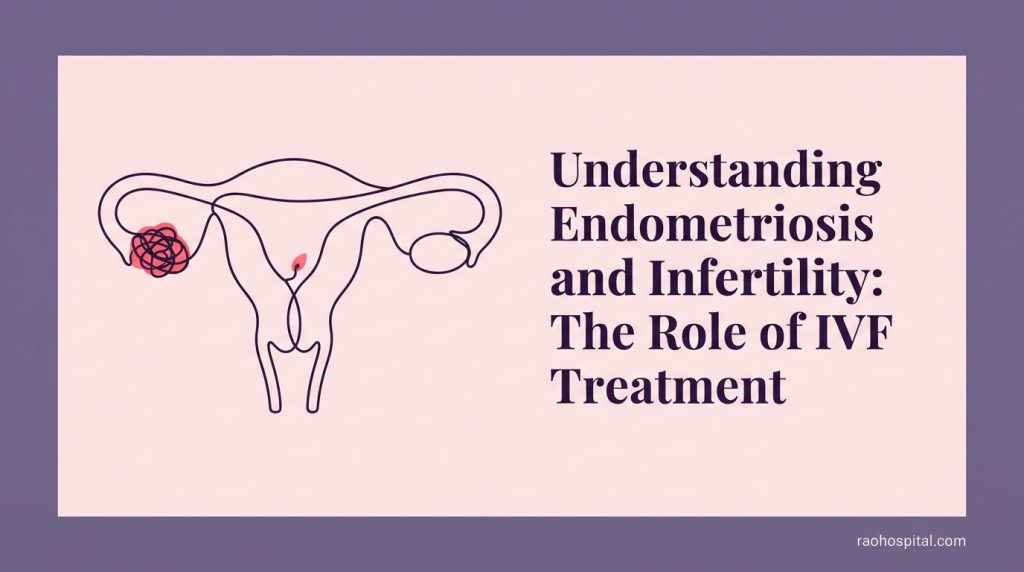
If you have endometriosis, trying to conceive can feel like living with two different kinds of uncertainty at once: the monthly pain and the unanswered question of whether pregnancy will happen. Many couples quietly carry this worry for years, especially when scans look “mostly normal” or when symptoms have been brushed aside.
The truth is that endometriosis and infertility are closely linked, but they are not the same story for every woman. With the right diagnosis and a step-by-step plan, many families do go on to have healthy pregnancies, sometimes naturally and sometimes with treatment like IVF.
Understanding Endometriosis and Infertility: The Role of IVF Treatment
Endometriosis is a condition where tissue similar to the uterine lining grows outside the uterus, commonly around the ovaries, fallopian tubes, and pelvic lining. It can cause painful periods, pain during intercourse, bowel discomfort, chronic pelvic pain, and fatigue. Some women, however, have minimal symptoms and discover it only during an infertility work-up.
When we talk about Endometriosis Treatment, it helps to know that the condition is common and often underdiagnosed. Around 30 to 50 percent of women with endometriosis experience infertility, and among women seeking infertility care, roughly 20 to 50 percent may have endometriosis.
How endometriosis affects fertility (more than one pathway)
Endometriosis can affect fertility through a mix of structural and “micro-environment” factors. This is why two women with the same stage of disease can have very different fertility experiences.
Common fertility-impacting mechanisms include:
- Pelvic adhesions that can distort normal anatomy
- Blocked or damaged fallopian tubes, affecting egg pickup and transport
- Ovarian cysts (endometriomas) that may reduce egg reserve over time
- Inflammation and immune changes in the pelvis that can affect sperm, egg, and embryo interaction
- Changes in the uterine lining that can reduce implantation receptivity
For many patients, the challenge is not only egg quality, but also egg quantity, especially when endometriosis involves the ovaries or when prior surgeries have affected ovarian reserve.
Stages of endometriosis and what staging really means for fertility
Endometriosis is commonly described in stages (I to IV), based on the amount, depth, and location of disease, and the presence of adhesions and endometriomas.
A helpful way to understand staging:
- Stage I to II (minimal to mild): smaller superficial implants, fewer adhesions
- Stage III to IV (moderate to severe): larger lesions, dense adhesions, ovarian endometriomas, deeper involvement
Staging offers clues, but it does not predict fertility on its own. Symptoms, age, ovarian reserve (AMH and ultrasound follicle count), tubal status, and semen parameters matter just as much.
When to suspect endometriosis in an infertility journey
Some couples reach IVF conversations without ever being told that endometriosis could be a factor. Consider a reproductive health consultation if you relate to any of the following:
- Severe period pain that affects daily life
- Pain during intercourse
- Infertility for 12 months (or 6 months if the woman is over 35)
- Known ovarian cysts labeled as “chocolate cysts” or endometriomas
- A history of pelvic infection, surgeries, or unexplained infertility
- Family history of endometriosis
At Rao Hospital, the evaluation is designed to be thorough but not overwhelming, combining history, examination, targeted imaging, and fertility testing as needed.
For ongoing care, patients can access our comprehensive gynaecology services that connect symptom relief and fertility planning under one experienced team.
Diagnosis: why it can take time, and what tests are useful
Endometriosis is not always visible on routine scans. Ultrasound can identify endometriomas and sometimes signs of deep disease, but smaller implants and adhesions may be missed. MRI may be advised in select cases, especially when deep infiltrating disease is suspected.
Laparoscopy remains the most definitive way to confirm and treat endometriosis in the same sitting, particularly when symptoms are significant or when anatomy needs direct assessment.
Treatment options before IVF: what helps, what does not, and why
Many women ask whether tablets alone can “clear” endometriosis and restore fertility. Hormonal medications can reduce pain and suppress disease activity, but they do not directly improve chances of conception while you are taking them, because they also prevent ovulation.
A practical fertility-focused pathway may include:
- Expectant management (trying naturally for a defined period)
- Surgery in selected cases
- Ovulation induction with IUI in minimal or mild disease
- IVF when time, age, stage, or prior outcomes make it the strongest option
The right choice depends on your age, how long you have been trying, ovarian reserve, tubal status, semen analysis, and how much endometriosis is affecting pelvic anatomy.
The role of laparoscopic surgery: when it supports fertility, and when to be cautious
Surgery can improve spontaneous pregnancy rates in early-stage endometriosis. In moderate to severe disease, expert surgery may also help selected couples conceive naturally, especially when there are no other infertility factors.
However, surgery is not automatically the best next step for everyone, especially when endometriomas involve the ovary. Removing ovarian endometriomas can reduce ovarian reserve, which can affect IVF response later. Current best practices generally do not recommend routine removal of endometriomas before IVF unless there are specific reasons such as severe pain, suspicion of malignancy, or concern about access to follicles during egg retrieval.
When surgery is appropriate, it should be done with fertility preservation in mind. Rao Hospital offers laparoscopic surgery for endometriosis through a minimally invasive approach, with careful attention to protecting ovarian tissue wherever possible.
IVF for endometriosis: why it is often the most effective option
IVF is widely regarded as the most effective treatment for endometriosis-associated infertility, particularly in moderate to severe disease or when time matters.
IVF helps because it can:
- Bypass tubal blockage or pelvic adhesions
- Improve timing and chances by controlling ovulation and fertilization
- Allow embryo development monitoring before transfer
- Reduce the pressure of “waiting and hoping” month after month
IVF is often recommended when:
- Endometriosis is stage III or IV, especially with pelvic distortion
- The woman is 35 or older, where egg reserve and time are critical
- There is low ovarian reserve or prior ovarian surgery
- IUI cycles have failed, or surgery has not restored fertility
- There are additional factors like male-factor infertility
In some advanced cases, your specialist may advise a period of medical suppression before IVF (often 3 to 6 months), which has been associated in some studies with improved pregnancy chances, likely by calming inflammatory activity and improving implantation conditions.
What IVF looks like in real life (and how we individualize it)
A common fear is that IVF will be “one standard protocol for everyone.” With endometriosis, personalization matters.
An individualized IVF plan may include:
- Ovarian reserve testing (AMH and ultrasound follicle count) to set realistic expectations
- Choosing stimulation protocols based on reserve, age, and prior response
- Planning egg retrieval with extra caution if anatomy is distorted
- Embryo transfer timing based on uterine lining and symptom profile
Some couples also ask about fertility preservation. If ovarian reserve is falling or surgery is anticipated, options like egg and sperm freezing treatment may be discussed as part of a longer-term family-building plan.
If you would like your plan reviewed by an expert fertility specialist in Coimbatore, Dr. Damodar R. Rao, you can expect a clear explanation of choices, timelines, and what each step is meant to achieve, without pressure and without false promises.
IVF vs IUI vs surgery: a simple decision framework
Every couple deserves a plan that respects both biology and emotional bandwidth. The table below offers a general framework that your clinician will tailor to you.
| Situation | Often-considered options | Why it may fit |
| Stage I to II, age under 35, good ovarian reserve | Timed intercourse, surgery in selected cases, ovulation induction with IUI | Reasonable time window, anatomy often less distorted |
| Stage I to II, age over 35 or prolonged infertility | Faster move to IVF, or limited IUI attempts | Time-sensitive; improves chances per cycle |
| Stage III to IV, adhesions or tubal distortion | IVF often preferred; surgery selectively | IVF bypasses pelvic factors and shortens time to pregnancy |
| Endometrioma present with low AMH | IVF planning with caution about surgery | Protect ovarian reserve, avoid repeat ovarian injury |
| Significant pain affecting quality of life | Symptom-focused treatment plus fertility roadmap | Balances comfort and conception goals |
This is not a substitute for individualized care, but it can help you ask the right questions at your next visit.
IVF outcomes in endometriosis: setting realistic expectations
It is true that IVF success rates in women with endometriosis can be slightly lower than in certain other infertility causes, particularly when ovarian reserve is reduced or when disease is severe. But IVF still offers strong per-cycle chances and is often more effective than repeating surgeries or extending low-yield treatments for too long.
Factors that most influence outcomes include:
- Age (especially above 35)
- Ovarian reserve (AMH and follicle count)
- Stage and ovarian involvement (endometriomas, prior surgery)
- Presence of additional factors like male-factor infertility
- Overall uterine health and endometrial receptivity
A trustworthy clinic will focus on cumulative outcomes and a stepwise plan, not just one cycle.
Myths that deserve a gentle correction
Myth: Endometriosis always causes infertility.
Reality: Many women with endometriosis do conceive. The risk varies, and the right plan makes a difference.
Myth: IVF does not work if you have endometriosis.
Reality: IVF is often the most effective option, especially when anatomy is affected or time is limited.
Myth: You must remove all endometriomas before IVF.
Reality: Routine removal is not always recommended because it can reduce ovarian reserve. Decisions should be individualized.
Myth: Hormone tablets alone can fix endometriosis-related infertility.
Reality: They help symptoms and may support IVF preparation in some cases, but they are not stand-alone fertility treatment.
After conception: why pregnancy may need closer monitoring
Endometriosis does not automatically stop mattering once you are pregnant. Research shows higher risks of complications such as preterm birth, hypertensive disorders like pre-eclampsia, placental complications, and higher cesarean rates compared to women without endometriosis.
This is where specialist-led antenatal care is valuable, especially for women who conceive after fertility treatment or who have a history of severe disease. At Rao Hospital, fertility care and maternity care sit within one legacy institution, making continuity of care smoother and safer.
Questions to ask at your consultation
If you are feeling stuck, these questions can bring clarity quickly:
- What stage or type of endometriosis do you suspect, and how confident are we without laparoscopy?
- What do my AMH and ultrasound suggest about ovarian reserve today?
- Is surgery likely to improve fertility in my case, or could it reduce ovarian reserve?
- Should we try IUI first, or move to IVF given my age and timeline?
- What is our plan if the first approach does not work within a defined time frame?
A good plan is not just a treatment. It is a timeline you can live with.
Rao Hospital has walked alongside families in Tamil Nadu since 1953, combining ethical decision-making with deep experience in reproductive medicine, including over 45 years of fertility expertise and more than 30,000 successful infertility treatments since 1985 through CARE, our Centre for Assisted Reproduction and Endoscopy.
Don’t let endometriosis stand in the way of your parenthood dreams. Schedule a consultation with the best fertility specialists in Coimbatore at Rao Hospital today for a personalized fertility roadmap. If you are ready to take the next step toward parenthood or need expert guidance on your fertility journey, the team at Rao Hospital is here for you. With over 70 years of compassionate care and trusted clinical leadership, you are in safe hands. Call us at +91 96299 19191 or visit www.raohospital.com to schedule your consultation today.